
ArkCloud Rehab
Charge capture
Everything delivered and not yet billed, with the reason each item is held. It exists because 'the service happened and was never billed' is otherwise invisible until a timely-filing deadline has already passed.
Written for: Rehab operations · Billing and RCM teams · Clinical supervisors · Evaluators
What the worklist is for
Launcher → ArkCloud Rehab → Records and revenue → Billing
The sidebar entry is Billing; the screen it opens is titled Charge capture.
The clinical side knows a service was delivered. The billing side knows how to bill it. The gap this screen closes is that neither could see which services were stuck, or why.
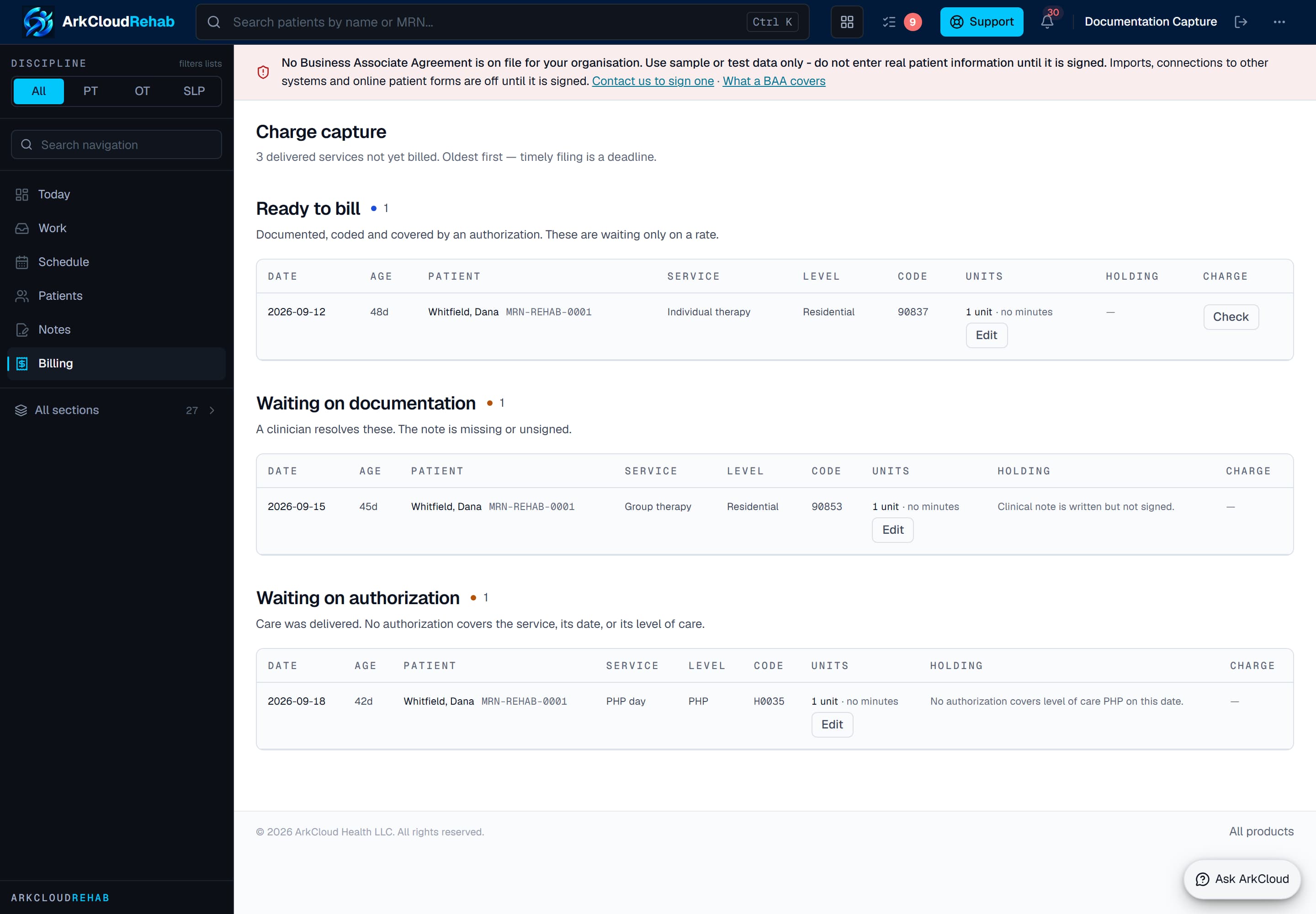
Real screen · synthetic data. The charge-capture worklist, grouped by what is holding each item rather than listed flat. Items are ordered oldest first, because timely filing is a deadline and a newest-first queue buries the item about to expire.
/rehab/billing
Where a billable service comes from
A row reaches this worklist in one of two ways, and only these two:
- Completing the visit. When a visit is completed, the service is recorded from the catalogue service the appointment was booked under, with that service's procedure code. A catalogue service with no code is recorded without one and held as Not ready, naming the missing configuration.
- Record service. Staff can record the delivered service for an encounter by hand from Encounters → Record service.
Nothing creates a charge automatically. Completing or signing a visit only refreshes the service's billing readiness - Ready to bill, or held with a reason. A charge is created only when a person with fee-management permission selects Post charge on a Ready to bill row.
The groups, and who resolves each
| Field or control | What it means |
|---|---|
| Ready to bill | Documented by a signed note, coded, with coverage and any required authorization in place. A person with fee-management permission posts these as charges (below). Nothing a clinician does will move them. |
| Waiting on documentation | A clinician resolves these: the note is missing, unsigned, missing a required section, documents a different visit, or was signed by someone who does not meet the signing requirements. Also held here: a note type that does not document a visit (a plan of care note, for example); a note amended by someone without signing authority, or with no recorded amender; a required co-signature that does not follow the last amendment, comes from the person who amended the note, or comes from a co-signer without signing authority; for Medicare, a treatment visit more than 10 treatment days (or your practice's stricter cadence) after the last signed progress report or re-evaluation; and a Medicare plan of care whose certification has no end date. A saved draft still holds the charge. |
| Waiting on authorization | The service is not covered by an approval. Worked through utilization review, not by re-documenting the visit. |
| Not ready | Usually an uncoded service, or one missing a diagnosis, rendering clinician, NPI, financial account or coverage. Also: a rendering clinician who did not hold signing authority on the date of service; a Medicare therapy line without the right GP, GO or GN modifier (added automatically from the episode's discipline when it can be, held when the episode is multidisciplinary, the line carries the wrong one or already has four modifiers); and, only where the platform's Medicare KX threshold is configured, a Medicare line past that threshold without KX. Procedure codes are never inferred - a qualified coder assigns them. |
Posting a ready service as a charge
Each Ready to bill row has a control to check the price and post it. Posting creates the charge on the patient's account in the RCM ledger, at the rate your fee schedule sets for that payer, procedure and date of service. Posting the same service twice returns the existing charge rather than creating a second one.
Posting is a deliberate, per-row action, not an automatic transition. Plan for somebody to own "ready to bill" as a recurring task, in the same way somebody owns unsigned documentation.
Once a charge is posted in ArkCloud RCM, the rest of the cycle proceeds normally - see the patient revenue cycle.
Working the list
Highest value first:
- Oldest items in any group. The list is already ordered this way. Age is the risk, not volume.
- Waiting on documentation. One person can usually clear several at once, and it is the group most likely to be forgotten.
- Waiting on authorization. Slower to resolve, so start early.
- Ready to bill. A person with fee-management permission posts them.