
Waitlist and cancellation fees
Two sides of one problem: a booked slot that is not going to be used. The waitlist fills it. The cancellation policy decides whether the practice charges for it.
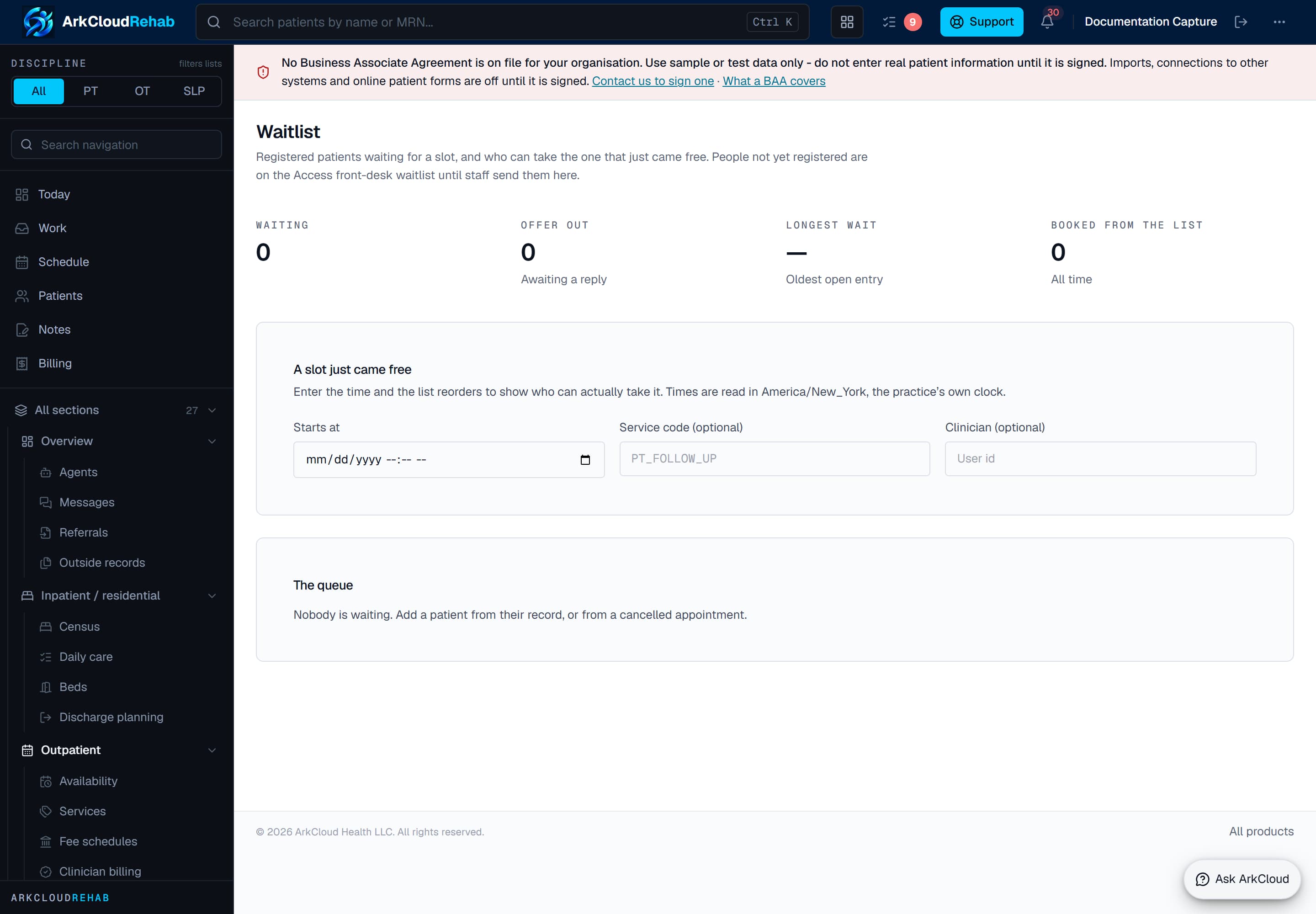
The waitlist holds patients awaiting capacity as records rather than as a note on a desk, so a slot that cancels at short notice can be offered from a list.
Empty state. Captured in a demonstration organisation with no records of this type yet. The controls, columns and filters are the ones a populated screen uses.
/rehab/waitlist
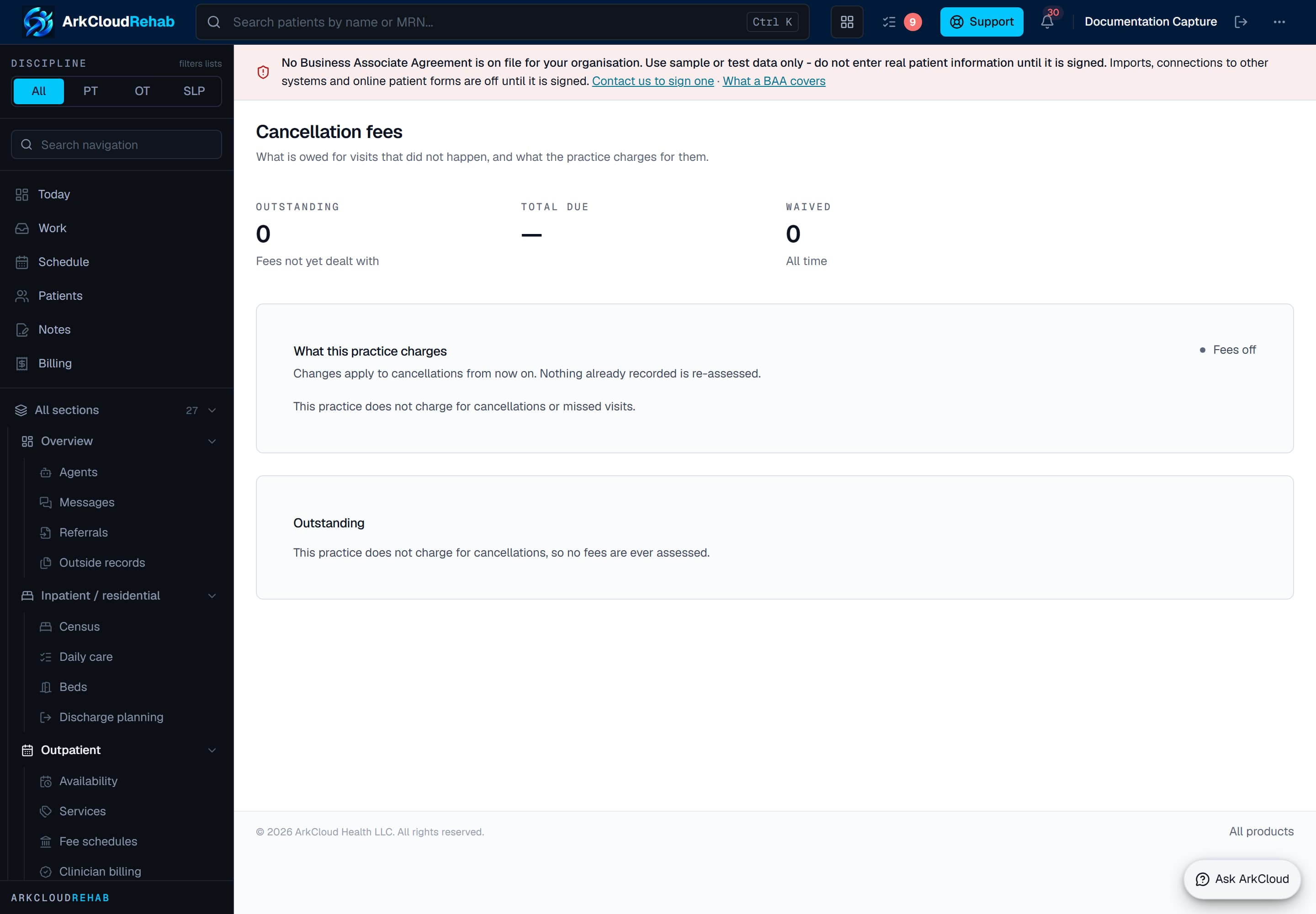
The cancellation fee worklist: what is owed against missed and late-cancelled appointments, and what has been waived. A fee nobody can see is a fee nobody collects.
Empty state. Captured in a demonstration organisation with no records of this type yet. The controls, columns and filters are the ones a populated screen uses.
/rehab/fees
Who is waiting
Rehab → Outpatient → Waitlist. Each entry is a real patient record, not a name on a list, which is what lets it end in an appointment. Add someone from their patient page with Add to waitlist.
An entry records when the person can actually come — which days, and between which hours. That is the difference between a waitlist that works and one nobody trusts: offering somebody a slot they cannot take wastes it twice, once on the offer and once on the silence that follows.
You can also record which service they are waiting for and whether it has to be a particular clinician. Leaving either blank means “anything”.
Filling a slot that came free
Enter the time on the Waitlist screen and the queue reorders to show who can take it. Everyone who cannot is still listed, each saying which of their own constraints ruled them out — so “nobody matches” is never a dead end you have to guess at.
Times are read in your practice’s own timezone, not the browser’s. A scheduler working from home in a different timezone sees the same matches the front desk does.
Order is priority first, then who has waited longest. The tie-break matters: without it the same slot offered twice could produce two different “first” candidates, and you could not explain to a patient why they were skipped.
Offers, and what happens when nobody answers
Offering a slot records that you have offered it. It does not book the appointment. When the patient says yes, press They accepted: the visit is booked into the offered slot through the ordinary scheduler, with the same clinician checks, and the entry comes off the list in the same step. Nothing is ever booked into a slot a patient has not agreed to.
An offer expires. If nobody replies, the entry returns to the queue in its original place rather than being dropped, because nobody answering a phone at four in the afternoon is the offer failing, not the patient giving up.
Cancellation and no-show fees
Rehab → Outpatient → Cancellation fees. Fees are off until an administrator turns them on. Nothing is assessed and nobody owes anything until then.
The policy has four parts:
- Notice required. Cancelling with at least this much notice is free.
- Late cancellation fee and missed visit fee, set separately. Ringing ahead is a different act from not arriving, and charging the same for both tells patients there is no point ringing.
- Forgive the first one. On by default, so the forgiving is a rule rather than an uneven favour somebody has to remember.
Leaving a fee empty charges the visit’s self-pay price: the default rate for the service’s procedure code on your fee schedule, times its default units, on the appointment’s date. If the fee schedule has no rate for it, nothing is charged. Entering 0 charges nothing. The two are not the same.
A cancellation the practice makes is never chargeable, whatever the notice. That is why Cancel on the schedule asks whether the patient or the practice cancelled, and then shows straight away whether a fee is due.
What a fee is, and is not
ArkCloud records that a fee is due. It does not charge a card, raise an invoice or post to an account. Taking the money is a separate, deliberate act through billing.
That is on purpose: a charge that appeared the moment a receptionist clicked “cancel” would be a billing action nobody had consented to, and the first anyone would hear of it is a disputed payment.
Waiving a fee
Only an administrator can waive, and a waiver needs a reason — the database refuses one without it. “Fee waived” with no name and no reason is indistinguishable from a bug that cleared it, and this is money a patient was told they owed.
The amount is kept. The record says “this was owed and forgiven”, not “nothing was ever owed” — which is the difference you need when a patient asks why the same missed visit was free last time.
Changing the policy later
Changes apply to cancellations from that point on. Nothing already assessed is recalculated, and each appointment keeps a record of how much notice was actually given, so a dispute months later is answerable from the appointment rather than from a policy that has since changed.