
Documentation
ArkCloud Care
Care coordination built around a governed pathway library: multidisciplinary teams, coordination tasks and the queues they are worked from, follow-ups, outreach, transitions of care, chronic and remote care programmes, and care gaps, risk tiers and population cohorts driven only by rules your organisation publishes.
The published pathway library is empty. ArkCloud ships no care pathway, care-gap rule or risk model. Nothing can be applied to a patient until your organisation authors one and it clears the publication gate below - the gate is the reason the library starts empty, rather than an obstacle to filling it.
Who can open it. ArkCloud Care requires the Care entitlement, Care switched on for the deployment, and the Supervisor, Admin or Super Admin role. Authoring, reviewing and publishing pathways, care-gap rules and risk models, creating and changing task queues, and deleting tasks, outreach, teams, transitions and cohorts are administrator-only.
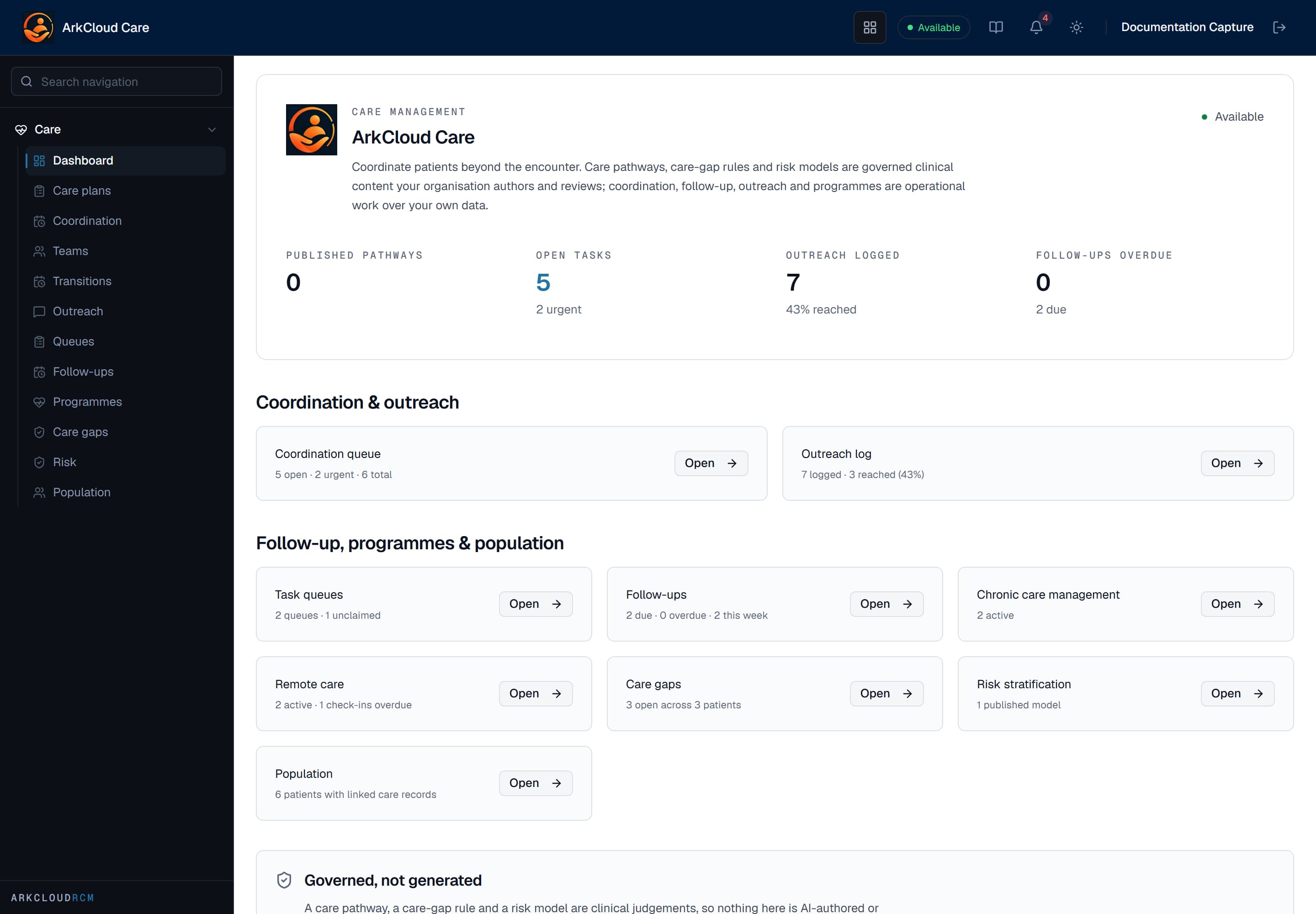
The ArkCloud Care dashboard: published pathways, open coordination tasks, outreach logged and overdue follow-ups, with links into programmes and population. The pathway count is zero until your organisation publishes one.
/care/dashboard
How a pathway becomes usable
- 1.Draft. A pathway is written against a named condition. It may not leave this state without a name, a body, and a human-readable source citation the care team can review.
- 2.Clinical review. A reviewer who is not the author records clinical approval. Until a different person approves, the approval field stays null and the pathway cannot advance.
- 2a.Rights and legal sign-off. A legal sign-off is recorded and the rights position is cleared. A pathway whose rights are unknown or restricted cannot publish, and a labelled sample can never publish.
- 3.Published. Only now is the pathway visible to the workspace and applicable to a patient. Versions are additive - a change is a new version, so a pathway already in use cannot be edited underneath the people following it.
The publication gate
A pathway may leave DRAFT only once it has a name, a body and a source citation. The allowed status transitions are enumerated; anything not listed is rejected rather than tolerated.
Four-eyes clinical review
Clinical approval must be recorded by someone other than the author. A pathway cannot be written and approved by the same person, so self-publication is unrepresentable.
Care teams and coordination
Multidisciplinary teams, and a coordination task queue for the work that falls between visits rather than inside one.
Transitions of care
Movement between settings and the follow-up it generates, recorded as history rather than by overwriting where the patient currently is.
Queues and follow-ups
Coordination tasks routed into named queues and claimed by one person at a time, and dated follow-up commitments recorded as completed, missed or cancelled - repeating ones schedule the next.
Chronic and remote care programmes
Enrollment with recorded consent and an eligibility attestation, care-management time against a target you set, and a remote check-in schedule. Recorded, not billed; no device feed.
Care gaps, risk and population
Gaps and risk tiers raised only by rules and models your organisation authored and published through the same gate as a pathway, and saved cohorts that become task-queue worklists.
Built and working today
Read from the application's own capability registry, so this list cannot claim something the code has not built.
- Care plans
- Patient outreach
- Transitions of care
- Chronic care management
- Care coordination
- Patient follow-up
- Task queues
- Care gaps
- Risk stratification
- Population health workflows
- Multidisciplinary care teams
- Remote care workflows
Related: Security covers tenant isolation and access control across every product.