
ArkCloud Clinical
Decision support
A reference aid a clinician drives, not a system that decides. It restates published, cited guidance and points at the passage that applies; the clinician reviews the source and makes every clinical judgement.
Written for: Clinicians · Clinical leadership · Compliance and regulatory reviewers · Security reviewers · Evaluators
What you will see today
Launcher → ArkCloud Clinical → Decision support
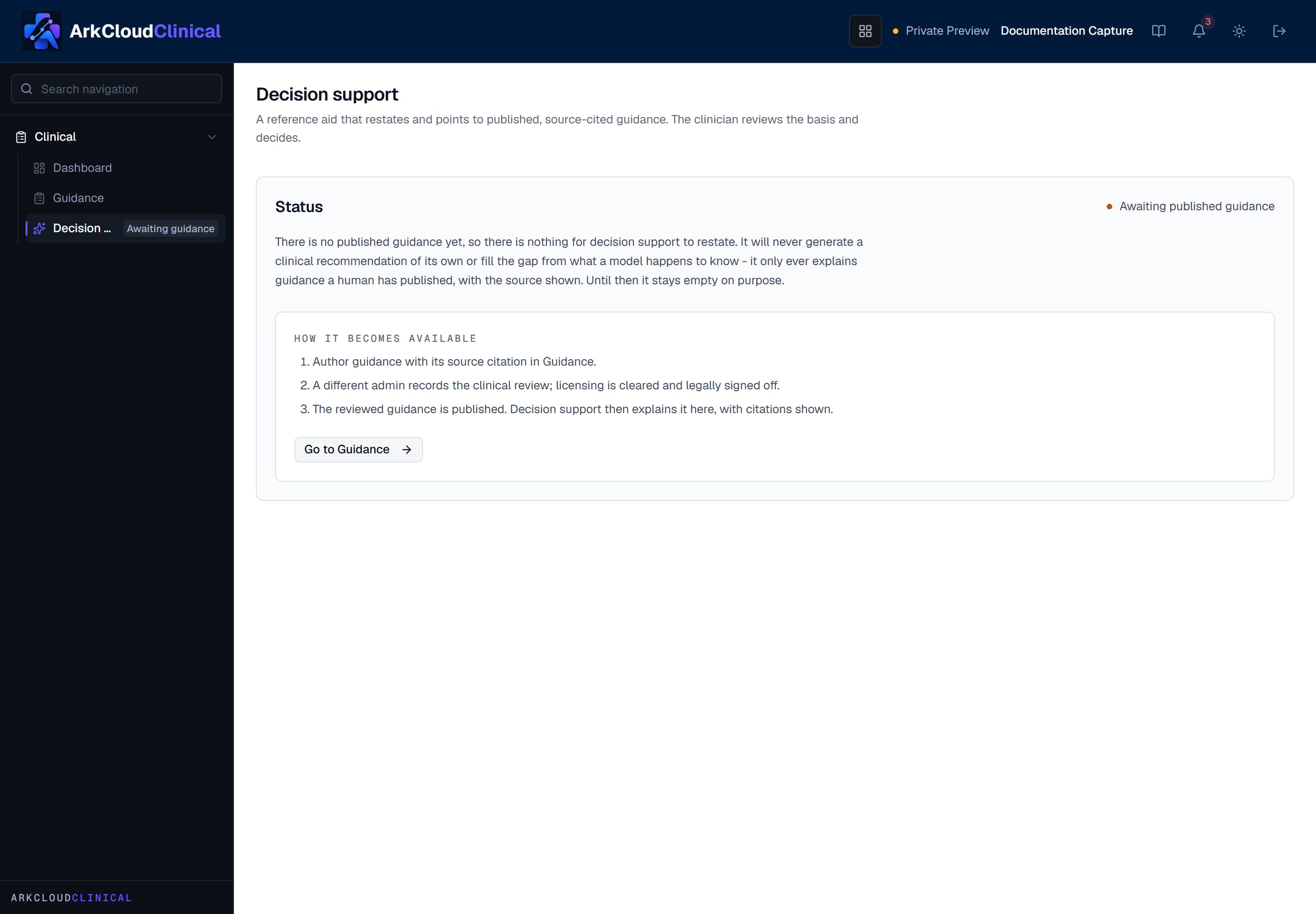
Decision support answers only from published guidance. With no guidance published, it returns nothing and says why, rather than falling back on a model's own knowledge to produce something plausible.
Not yet usable. This capability is implemented and cannot be used until something outside the software exists - published clinical content, or a live payer or payment connection. The screen states the reason rather than offering a control that would fail.
/clinical/decision-support
The screen has a question box, but only once guidance is published. While nothing is published it shows its status and no question box, because there is nothing to answer from. Once guidance is published, a clinician picks a published item, asks a question, and sees the answer with that item's sources - or a plain reason why no answer was given. Whether a permitted model is configured for a given deployment is a separate condition - with none, the screen reports that no model is available.
The rule it is built on
AI may explain a published, governed value. It may never be the source of one.
Everything else follows from that. The service is handed guidance that has already been written, reviewed, licensed and published, together with the citations it rests on, and its only job is to help a clinician find and understand that text in relation to their question.
It is explicitly forbidden from introducing, inferring, calculating, adjusting, diagnosing or recommending any value, dose, cut-off, score, risk level, diagnosis or course of action that is not already present in the guidance it was given. Where the guidance does not address the question, it says so and stops rather than filling the gap.
What it refuses, and why
| Field or control | What it means |
|---|---|
| No published guidance | There is no path to a draft, a computed value, a registry, or the model's own knowledge. Without published guidance there is nothing it is permitted to speak from. This is the current state. |
| No citation | Guidance with no source citation is refused. Support a clinician cannot trace back to a named source is the thing that turns a reference aid into something else. |
| Egress blocked | Clinical content may only reach a model on the application's own host, or on a private-network machine that the operator has explicitly acknowledged and that is reached over TLS. Any other endpoint - including any external or third-party provider - is refused before any clinical text is sent. |
| AI unavailable | No model is configured. It reports that rather than degrading to a different source of answers. |
| AI error | The model was asked and failed or returned nothing. Reported as an error, never replaced with a fallback answer. |
The regulatory position, stated carefully
Clinician-facing software that produces patient-specific recommendations is regulated as a medical device unless the clinician can independently review the basis of what it says - that is, unless they are not being asked to rely on it as the primary source of a clinical judgement.
ArkCloud Clinical is designed to sit inside that criterion: it restates already-published, already-cited, human-reviewed text, shows the citations beside the output, and never produces a patient-specific recommendation.
Where clinical text goes
What it is not
- Not a diagnostic tool. It produces no diagnosis and no patient-specific recommendation.
- Not a general assistant. It has no access to its own knowledge as a source; outside the guidance it was handed, it has nothing to say.
- Not a substitute for reading the guidance. The citations are shown because reviewing them is the point, not a formality.
- Not autonomous. It answers a clinician's question and takes no action.